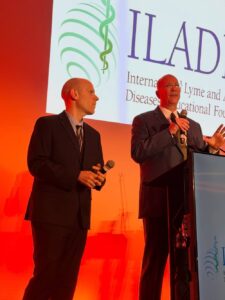

What happens when an active-duty Air Force officer, elite athlete, and aspiring astronaut suddenly finds his health slipping away—and no one can explain why?
In this episode of the Tick Boot Camp Podcast, we sit down with Major Trent Vonich, a United States Air Force officer whose relentless pursuit of answers led him through years of unexplained symptoms, medical uncertainty, and ultimately a diagnosis of Lyme disease and multiple tick-borne infections.
Trent shares his remarkable journey from military service and elite physical performance to chronic illness, recovery, and a renewed mission focused on research, education, and helping others navigate the challenges of tick-borne disease.
His story is one of resilience, perseverance, and discovering that purpose can evolve even when life takes an unexpected turn.
Meet Major Trent Vonich
Major Trent Vonich is an active-duty United States Air Force officer, former Combat Rescue Officer, endurance athlete, researcher, and PhD candidate whose life changed dramatically after developing a complex chronic illness linked to tick-borne infections.
Throughout his military career, Trent pursued some of the Air Force’s most demanding opportunities while maintaining a passion for endurance sports, leadership, and scientific inquiry.
When mysterious symptoms began impacting his health and performance, he embarked on a years-long search for answers that would ultimately reshape both his personal and professional life.
Today, he continues serving his country while advancing research, education, and awareness surrounding complex chronic illnesses.
A Life Built Around Performance
Before illness entered the picture, Trent’s life revolved around excellence.
As a Combat Rescue Officer, he trained and operated in one of the military’s most physically and mentally demanding environments. Outside of his military duties, he pushed himself through endurance athletics and maintained an unwavering commitment to peak performance.
Fitness, resilience, discipline, and service were central to his identity.
Then everything began to change.
When Symptoms Started to Appear
What began as subtle health concerns gradually developed into a constellation of symptoms that became increasingly difficult to ignore.
Trent experienced:
- Severe fatigue
- Brain fog
- Sleep disturbances
- Cognitive challenges
- Chronic pain
- Exercise intolerance
- Neurological symptoms
- Autonomic dysfunction
- Reduced athletic performance
- Unexplained declines in overall health
As symptoms progressed, activities that once felt routine became increasingly difficult.
Like many Lyme disease patients, he found himself knowing something was wrong long before he had an explanation.
The Long Search for Answers
Despite extensive medical evaluations, Trent struggled to find a diagnosis that fully explained what he was experiencing.
He consulted numerous healthcare providers, underwent extensive testing, and explored a variety of possible explanations for his symptoms.
Yet many of the answers fell short.
The experience highlighted a challenge familiar to many in the Lyme community: living with very real symptoms while struggling to obtain clear answers from the medical system.
As his condition continued to impact both his health and career, the search became increasingly urgent.
Discovering Lyme Disease and Co-Infections
Eventually, Trent’s investigation led him to the possibility of tick-borne disease.
Further evaluation revealed Lyme disease along with associated co-infections, helping explain the complex and multisystem nature of his symptoms.
For the first time, many of the seemingly unrelated health issues began to fit together.
The diagnosis provided validation, clarity, and a path forward.
But as many patients discover, receiving a diagnosis is often only the beginning of the journey.
Treatment, Recovery, and Rebuilding Health
Trent discusses the comprehensive approach he used to address his illness and begin rebuilding his health.
His recovery journey included:
- Treating Lyme disease and co-infections
- Addressing inflammation and immune dysfunction
- Improving sleep quality
- Optimizing nutrition
- Modifying exercise and training strategies
- Managing stress and recovery capacity
- Long-term health monitoring
Rather than relying on a single intervention, Trent learned that recovery required addressing multiple aspects of health simultaneously.
His experience reinforces an important lesson for many chronic illness patients: healing often requires persistence, patience, and a willingness to adapt.
The Mental and Emotional Impact of Chronic Illness
For someone whose identity was deeply connected to physical performance, the emotional impact of chronic illness was profound.
Trent reflects on the challenges of watching his capabilities change while confronting uncertainty about his future.
The experience forced him to reconsider long-held assumptions about success, achievement, and self-worth.
Through that process, he developed a deeper understanding of resilience—one rooted not in physical performance alone, but in adaptability, perspective, and perseverance.
Navigating Chronic Illness While Serving on Active Duty
One of the most unique aspects of Trent’s story is that it unfolded while he continued serving in the United States Air Force.
During the interview, he discusses:
- Seeking medical care within the military healthcare system
- Balancing military responsibilities with chronic illness
- Communicating symptoms to healthcare providers
- Managing uncertainty during the diagnostic process
- Maintaining professional performance while struggling physically
- The challenges faced by service members dealing with complex chronic illnesses
His perspective offers valuable insight for active-duty military personnel, veterans, and first responders facing similar health challenges.
A Different Way to Serve
Lyme disease changed the trajectory of Trent’s military career, but it did not end his commitment to service.
Health challenges ultimately led him away from operational flying and special operations duties, requiring him to rethink some of his long-term career goals.
Rather than viewing those changes as an ending, Trent embraced a new mission.
Today, he continues serving through advanced academic research, doctoral studies, mentorship, and future teaching opportunities.
His story demonstrates that purpose is not tied to a single role or title. Sometimes life’s greatest challenges reveal entirely new ways to contribute and make an impact.
Lessons Learned Along the Way
Throughout the conversation, Trent shares several powerful lessons:
- Trust your instincts when something feels wrong.
- Persistence is often necessary to find answers.
- Chronic illness affects every aspect of life—not just physical health.
- Recovery is rarely linear.
- Identity can survive even when circumstances change.
- Resilience is built through adaptation.
- Service can take many forms.
- Purpose often emerges from adversity.
Why This Episode Matters
Major Trent Vonich’s story extends far beyond Lyme disease.
It is a story about perseverance in the face of uncertainty, the importance of self-advocacy, and the power of finding meaning when life does not go according to plan.
For Lyme disease patients, his experience provides validation that complex symptoms can be real even when answers are difficult to find.
For military members, athletes, and high performers, his journey serves as a reminder that strength is not defined solely by physical capability but by the willingness to continue moving forward despite adversity.
Most importantly, his story offers hope.
Resources & Links
Learn more about Lyme disease and tick-borne illness:
- Tick Boot Camp Podcast: https://tickbootcamp.com/podcast/
- Tick Bite Blueprint: https://tickbootcamp.com/tick-bite-blueprint/
- Why Lyme Persists: https://tickbootcamp.com/home/lyme-persists/
- Lyme Testing Information: https://tickbootcamp.com/home/lyme-testing/
- Tick Boot Camp Blog: https://tickbootcamp.com/blog/
Listen Now
If this episode inspired you, please subscribe, leave a review, and share it with someone who may benefit from hearing Trent’s story.
At Tick Boot Camp, we believe healing is possible, no one should face Lyme disease alone, and every story has the power to help someone else find hope.